From the archive Explainer
Arctic sea ice minimum ties for tenth lowest as Antarctic ice hits record lows
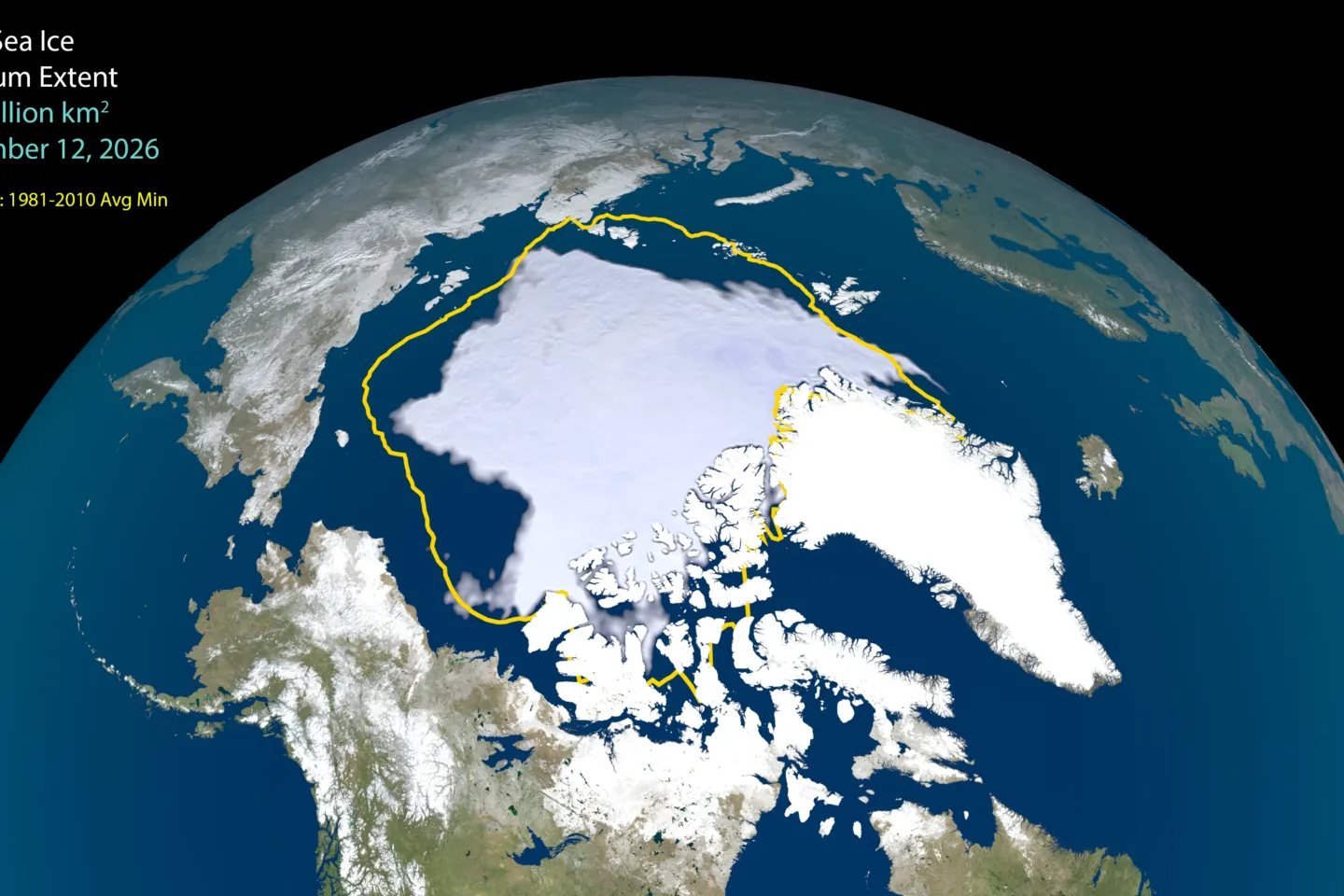
Arctic ice shrank to 4.60 million sq km on 12 September 2026 after an unusually cool, stormy summer. Scientists say the long decline has flattened for two decades, and they disagree about why.
- Event date
- Published
- Reading time
- 3 min
Key points
- Arctic sea ice reached its 2026 minimum on 12 September at 4.60 million sq km, tied for tenth lowest in the satellite record (NSIDC).
- The 20 lowest Arctic minimums have all occurred in the last 20 years, but there has been no significant further decline over that period.
- The summer was cool and stormy over the Arctic Ocean despite near-record global temperatures.
- Antarctic winter sea ice peaked at its third lowest level on record.
Every September, after a summer of melting, the floating ice that covers the Arctic Ocean shrinks to its smallest area of the year. In 2026 that point came on 12 September, when the ice covered 4.60 million square kilometres (1.78 million square miles), the US National Snow and Ice Data Center (NSIDC) and NASA announced on 23 September.
The figure ties with 2008, 2010 and 2025 as the tenth lowest in a satellite record that began in late 1978. It was not close to a record: the lowest minimum, 3.39 million square kilometres, was set on 17 September 2012. But it continued a run in which, as NSIDC put it, the 20 lowest minimums have all occurred in the last 20 years.
What is being measured
Sea ice is frozen seawater. Unlike glaciers and ice sheets, which sit on land, it is already floating. It grows through the autumn and winter and retreats in spring and summer.
“Extent” is the standard measure: the total area of ocean where satellites detect a meaningful concentration of ice. NSIDC, based at the University of Colorado Boulder, bases its figure on a five-day average of microwave measurements from satellites, a record maintained since NASA’s Nimbus-7 satellite began observing in October 1978 and continued today with a Japanese instrument, AMSR2.
Different groups process the same kind of data in different ways. The UK’s Met Office, using a European dataset, put the 2026 minimum at 5.06 million square kilometres, also on 12 September, and ranked it 14th lowest. It attributed the difference in ranking to several years’ minima lying very close together and to the sensitivity of the result to how satellite signals are converted into ice cover. On both analyses the 2026 minimum was about 1.5 to 1.6 million square kilometres below the 1981–2010 average — in NSIDC’s comparison, roughly the area of Alaska.
A cool summer in a hot year
The route to the minimum was unusual. In a fuller analysis published on 7 October, NSIDC said the ice had been tracking near record lows through May, before the rate of loss slowed sharply in June. A persistent low-pressure system sat near the North Pole from June into September, bringing a cool and stormy summer over the Arctic Ocean even as global air temperatures were at or near record highs for June to August. Ice lingered off the coast of Alaska into August, later than in recent years. NSIDC called the season “unusual in the extreme”.
Why the decline has flattened
Over the whole record, the September minimum has fallen by 11.8 per cent per decade relative to the 1981–2010 average, a loss of about 73,200 square kilometres a year, according to NSIDC. The centre added a caveat: there has been no significant decline in September minimum extents over the past two decades, and the causes of that flattening are, in its words, a matter of active debate.
One suggestion came from Linette Boisvert, a sea ice scientist at NASA’s Goddard Space Flight Center, who said in the agency’s statement that increased cloud cover over the last decade has limited melting driven by sunlight. Walt Meier, a senior research scientist at NSIDC, said the extent had plateaued but remained low compared with earlier in the record.
A flat line in area does not mean the ice has recovered. The Met Office calculated that the 2026 minimum was 0.75 million square kilometres above its long-term linear trend, yet still 1.51 million below the 1981–2010 average. And the ice that remains is younger and thinner than it once was. NSIDC’s October analysis said the ice surviving at the end of summer for more than one year has ranged between 1.3 and 1.9 million square kilometres since 2007, against about 3.5 million in the 1980s; ice more than four years old has amounted to 250,000 square kilometres or less every year since 2012, compared with about 1.5 million before 2005.
The sharper signal in the south
Antarctica’s seasons run opposite to the Arctic’s, so its sea ice reaches its winter maximum around the time the Arctic reaches its minimum. NSIDC’s 23 September announcement said Antarctic ice had been tracking near record lows for most of the growth season and had probably peaked on 14 September at 17.59 million square kilometres. If confirmed, that would be the third lowest maximum on record. The Met Office, on its dataset, gave the two lower maxima as those of 2023 and 2024.
NASA reported an abrupt episode in August, when Antarctic extent fell by about 300,000 square kilometres in six days before growth resumed. Meier attributed it to weather that pushed together thin, mobile ice at the outer edge, and said such events are common but this one was unusually large.
Both NASA scientists were cautious about calling the recent Antarctic lows a long-term trend. Because the Southern Ocean’s ice is not hemmed in by land, it varies far more from year to year than Arctic ice does.
Update
In its analysis of 7 October 2026, NSIDC confirmed 14 September as the date of the Antarctic maximum and its ranking as third lowest in the satellite record. It reported that Antarctic extent then dropped sharply through September and that daily values had been at record lows for the date since 2 October, passing those set in 2023. Losses were concentrated in the Ross and Amundsen seas and the Indian Ocean sector. In the Arctic, the September monthly average was 4.81 million square kilometres, the thirteenth lowest on record, and the ice refroze rapidly in early October.
Sources
- Arctic sea ice minimum ties for tenth lowest
- Arctic Sea Ice Reaches 2026 Annual Minimum Extent
- Briefing on Arctic sea ice minimum and Antarctic sea ice maximum report - September 2026
- “Stranger Things” in the 2026 Arctic
Spotted an error? See how to request a correction.