Rundown
Light-switched neurons, polar neutrinos, mirror molecules: 2026’s science Nobels
Six researchers in the United States, Germany, France and Japan were honoured between 5 and 7 October. What each prize recognised, and why the committees thought it mattered.
- Event date
- Published
- Reading time
- 3 min
Key points
- Medicine: Karl Deisseroth, Peter Hegemann and Georg Nagel, for light-gated ion channels and optogenetics.
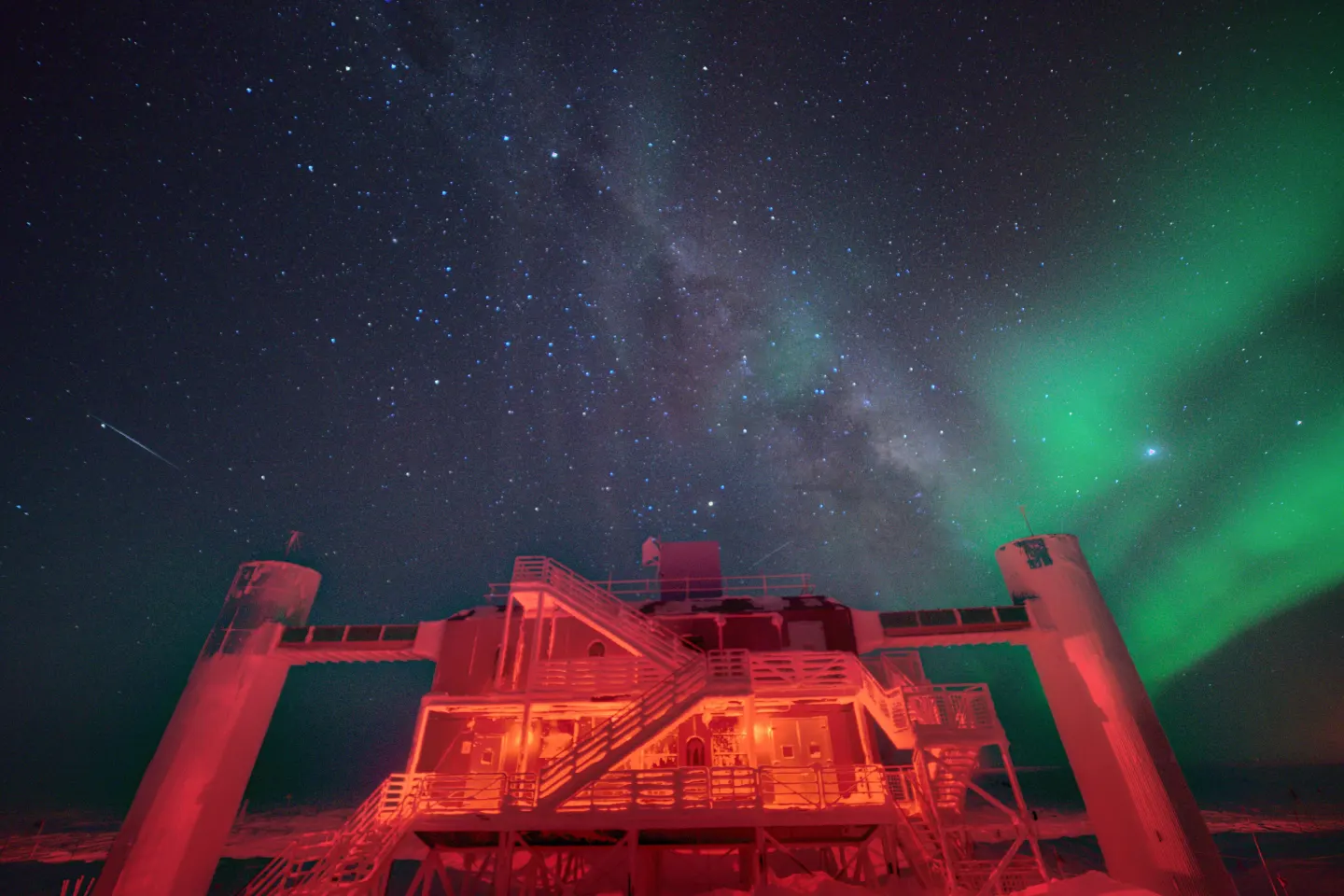
- Physics: Francis Halzen, for the IceCube Neutrino Observatory and the discovery of high-energy cosmic neutrinos.
- Chemistry: Henri B. Kagan and Kenso Soai, for non-linear effects and autocatalysis in asymmetric synthesis.
- Each prize is worth 12 million Swedish kronor.
The three Nobel Prizes in the sciences were announced in Stockholm on consecutive days from 5 to 7 October 2026. Each carries 12 million Swedish kronor, about $1.2 million according to Reuters, divided equally where there is more than one laureate. The medals are presented in Stockholm on 10 December, the anniversary of Alfred Nobel’s death.
This year’s awards went to a tool that transformed brain research, a telescope buried in Antarctic ice, and an answer to an old puzzle about the chemistry of life.
-
Physiology or medicine (5 October): a light switch for nerve cells. Karl Deisseroth of Stanford University and the Howard Hughes Medical Institute in the US, Peter Hegemann of Humboldt University of Berlin and Georg Nagel of the University of Würzburg shared the prize “for their discoveries concerning light-gated ion channels and optogenetics”, the Nobel Assembly at Karolinska Institutet said.
The story began with a single-celled alga, Chlamydomonas, which swims towards light. In the early 2000s Hegemann and Nagel identified the protein responsible, channelrhodopsin: when blue light strikes it, a channel opens and charged particles flow into the cell, producing an electrical signal. Any cell given the protein became sensitive to light. Deisseroth inserted the gene into rat nerve cells and showed in 2005 that a flash of blue light could make them fire; two years later the method worked in the brains of living mice.
Earlier methods could link brain regions to functions but could not prove cause and effect, the assembly said. Switching chosen cells on and off allows that, and researchers have used the technique to trace circuits behind particular memories, emotions and behaviours. It is also being tested in attempts to restore sight in people with visual impairment. The laureates are 54, 71 and 73 respectively, the Associated Press reported.
-
Physics (6 October): catching cosmic neutrinos at the South Pole. Francis Halzen of the University of Wisconsin–Madison, born in Tienen, Belgium, in 1944, received the prize alone “for decisive contributions to the IceCube Neutrino Observatory and the discovery of high-energy neutrinos of astrophysical origin”, the Royal Swedish Academy of Sciences said.
Neutrinos are particles that pass through the Earth, and through people, almost without trace. Only very rarely does one strike an atomic nucleus, producing a flash of light. Halzen proposed in 1988 that the clear glacial ice at the South Pole could serve as the detector. Because the highest-energy neutrinos from space are scarce, an enormous volume was needed: IceCube, completed in 2011, instruments a cubic kilometre of ice with light sensors.
Within a few years the collaboration reported neutrinos that must have come from far beyond the solar system. Unlike other particles, neutrinos travel without being deflected or losing energy, so they carry information about the violent environments that produce them. Mark Pearce, who chairs the physics committee, said Halzen’s “tenacity and scientific vision has paved the way for a new kind of astronomy”.
-
Chemistry (7 October): how molecules came to prefer one hand. Henri B. Kagan, professor emeritus at what was then Université Paris-Sud in France, and Kenso Soai, professor emeritus at Tokyo University of Science, were honoured “for the discovery of non-linear effects and autocatalysis in asymmetric organic synthesis”, the academy said. Kagan was born in 1930 and Soai in 1950.
Many molecules, including amino acids, exist in two forms that are mirror images of each other, like left and right hands. Living organisms use only one. Yet when chemists ran reactions capable of producing both, they obtained equal amounts of each, and how life’s one-handedness could have arisen was a mystery for more than a century.
In 1986 Kagan found a way of steering reactions to yield a greater excess of one mirror form than had been thought possible. Soai built on it: a 1995 paper described a reaction with the potential to produce a single form, and in 2003 he achieved it. The academy said the work has been decisive for chemists designing reactions to make pharmaceuticals, where often only one mirror form has the intended effect.
The remaining announcements in the 2026 Nobel calendar fell outside the natural sciences: literature on 8 October, peace on 9 October and, on 12 October, the economics prize that Sweden’s central bank added later.
Sources
- Press release: Nobel Prize in Physiology or Medicine 2026
- Press release: Nobel Prize in Physics 2026
- Press release: Nobel Prize in Chemistry 2026
- Nobel medicine prize goes to 3 scientists for research into brain activity
- Francis Halzen wins 2026 Nobel Prize in Physics
- Henri Kagan, Kenso Soai win 2026 Nobel chemistry prize
Spotted an error? See how to request a correction.