From the archive In brief
Newly found star circles the Milky Way’s black hole every 8.7 years
S301 comes closer to Sagittarius A* than any star tracked before, reaching 25,000 km per second. Its orbit could let astronomers measure how fast the black hole spins.
- Event date
- Published
- Reading time
- 1 min
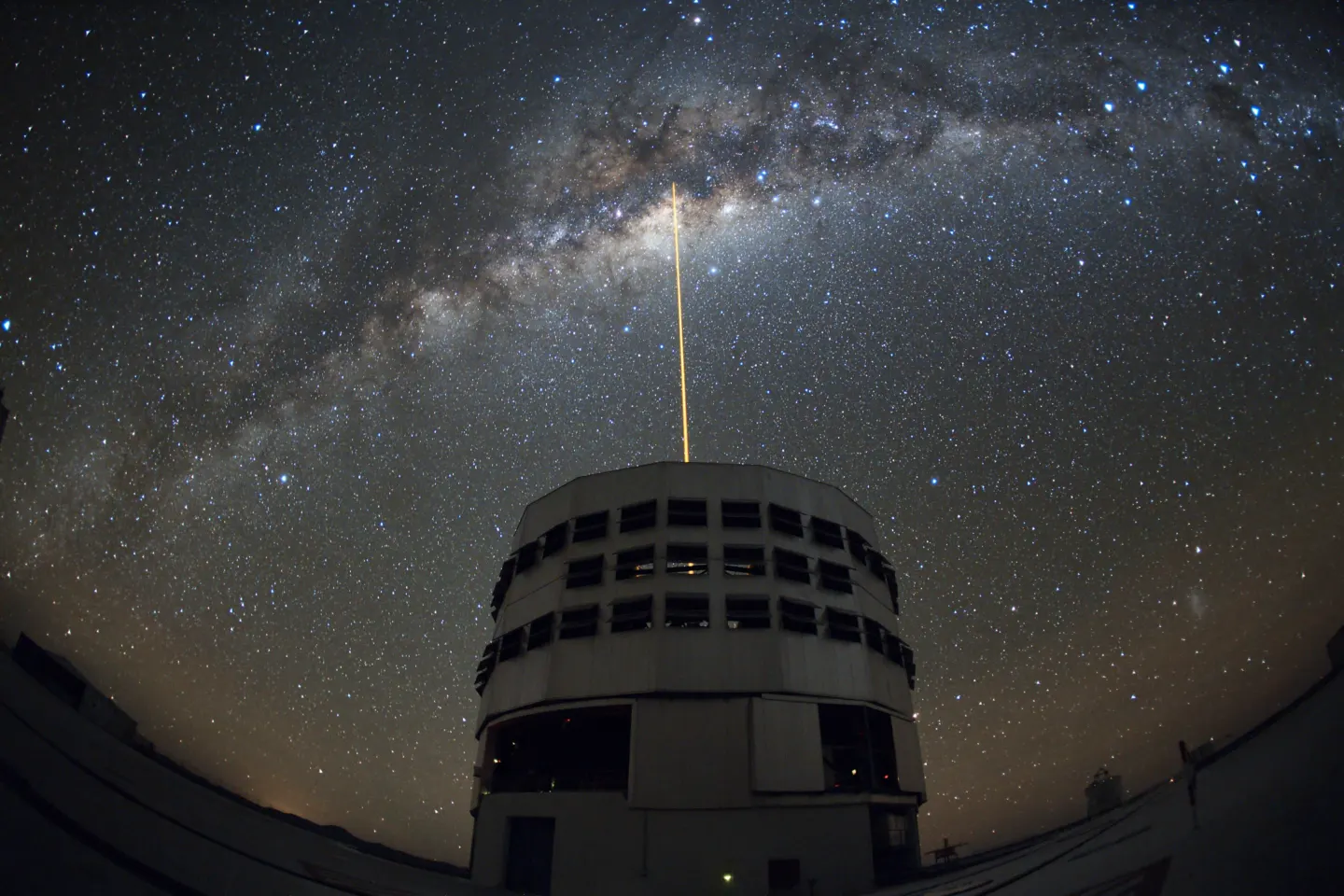
The shortest stellar orbit yet measured around the black hole at the centre of the Milky Way belongs to a faint star named S301, which completes a circuit in 8.7 years, according to a study published in the journal Nature on 19 August 2026.
The star was identified in images from GRAVITY, a near-infrared interferometric instrument on the European Southern Observatory’s Very Large Telescope in Chile. S301 first appeared in the data in spring 2023, Live Science reported; the team then found it in archived observations from 2021 and 2017, giving 19 measured positions over eight years.
Sagittarius A*, the black hole, has a mass about 4.3 million times that of the Sun and lies roughly 27,000 light-years away. A few dozen stars are known to orbit it. The best studied, S2, takes 16 years, and the previous shortest known orbit was 12 years. S301 follows a very elongated path and, at closest approach, reaches a peak speed of 25,000 kilometres per second — about 8 per cent of the speed of light.
That proximity is the point of interest. Earlier stars have confirmed effects predicted by Einstein’s general relativity that depend only on the black hole’s mass. A rotating black hole should also drag surrounding space-time with it, but the effect fades steeply with distance. The authors write that the motion of S301 is directly sensitive to the spin of Sagittarius A*, within the reach of current near-infrared interferometry and of future spectroscopy with an extremely large telescope.
No spin measurement has been made yet; the paper reports the discovery and the orbit. “Stars orbiting Sgr A* are very interesting objects, as they serve as luminous probes of the curved spacetime around the black hole,” co-author Felix Mang, a doctoral student at the Max Planck Institute for Extraterrestrial Physics in Germany, told Live Science.
The authors also suggest how the star got there: its highly eccentric orbit is consistent with S301 having once been part of a binary pair that the black hole’s gravity pulled apart, capturing one member.
Sources
- Discovery of a star sensitive to the spin of Sagittarius A*
- Astronomers spot the closest, fastest star ever seen orbiting our galaxy's monster black hole
Spotted an error? See how to request a correction.