From the archive Explainer
NASA’s Roman Space Telescope launches to survey the sky in wide angle
The observatory left Florida on a Falcon Heavy on 30 August 2026. Its camera sees an area at least 100 times larger than Hubble's, and fuel savings may let it work for two decades.
- Event date
- Published
- Reading time
- 4 min
Key points
- Launched 30 August 2026 from Kennedy Space Center on a SpaceX Falcon Heavy; separated from the rocket 31 minutes after liftoff.
- The 300-megapixel Wide Field Instrument has a field of view at least 100 times larger than Hubble's.
- Main aims: dark energy, dark matter and a census of planets around other stars.
- NASA said on 14 September that fuel savings give the mission potential for at least 22 years of operations; first images are expected by early 2027.
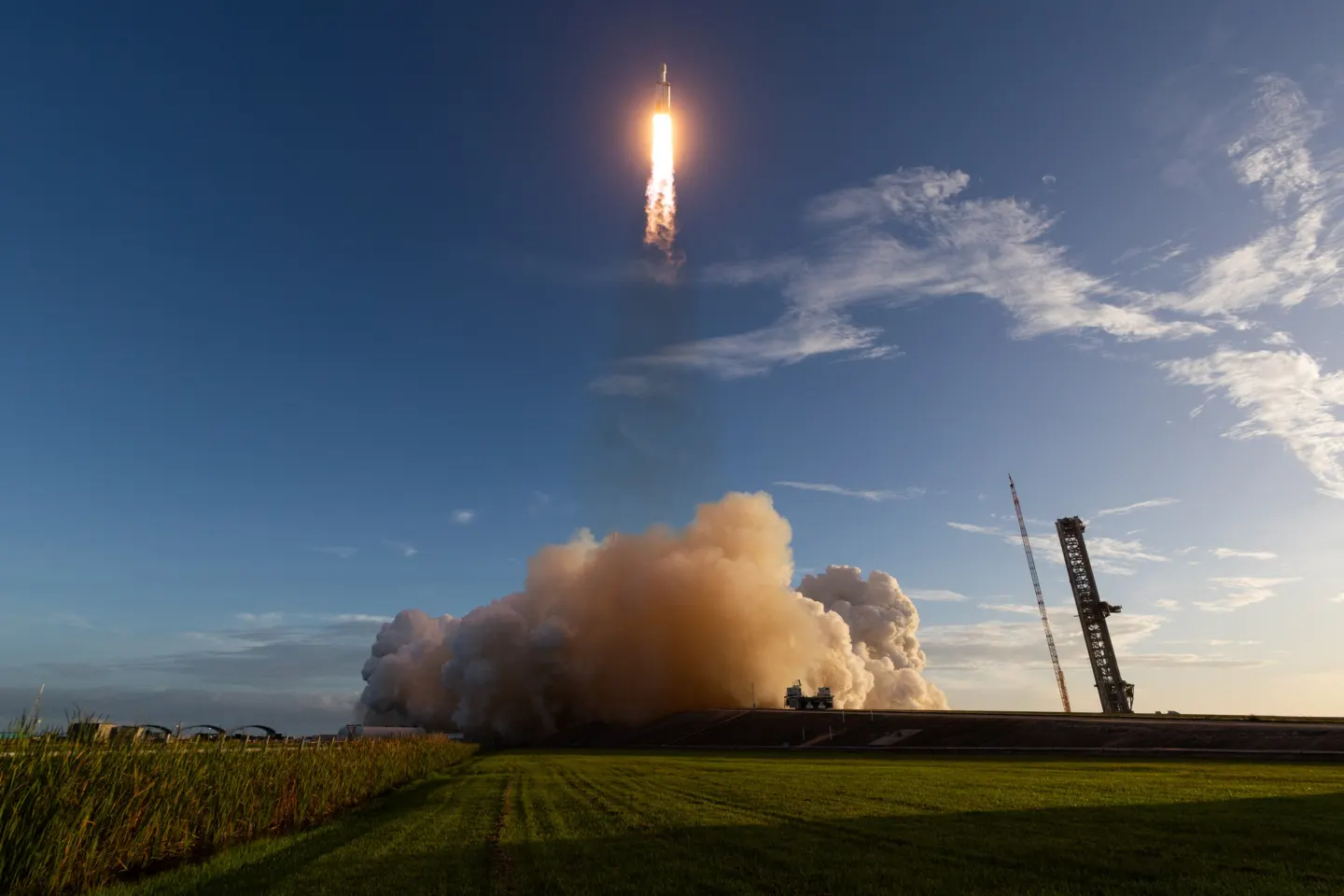
NASA’s Nancy Grace Roman Space Telescope lifted off from Launch Complex 39A at the Kennedy Space Center in Florida at 7:26 a.m. local time (11:26 UTC) on Sunday 30 August 2026, carried by a SpaceX Falcon Heavy rocket. Thirty-one minutes later, at 7:57 a.m., the observatory separated from the rocket’s upper stage and began a journey of about 1.5 million kilometres to its working position.
Roman is a NASA flagship observatory built for a different job from the Hubble Space Telescope. Hubble examines small patches of sky; Roman is designed to photograph very large areas with comparable sharpness, so that work which would take Hubble many years becomes a survey project.
What flew
The telescope’s main mirror is nearly eight feet (about 2.4 metres) across, about the same as Hubble’s. The difference lies behind it. Roman’s principal camera, the Wide Field Instrument, is a 300-megapixel infrared detector array made of 18 sensors. NASA says its field of view is at least 100 times larger than Hubble’s: each image covers a patch of sky bigger than the apparent size of the full Moon. The agency describes the telescope as able to survey the sky about a thousand times faster than Hubble.
A second instrument, the Coronagraph, is a technology demonstration. It blocks the glare of a star so that faint objects beside it, such as giant planets and discs of dust, can be imaged directly. NASA has said the techniques it tests could be used by a later mission designed to photograph Earth-like planets.
The observatory weighed 17,760 pounds (8,056 kilograms) at launch. It is named after Nancy Grace Roman (1925–2018), NASA’s first chief astronomer, whose advocacy for telescopes in orbit earned her the informal title “mother of Hubble”.
What it is for
NASA lists three main science aims. The first is dark energy, the name given to whatever is causing the expansion of the universe to accelerate. By measuring the light of an enormous number of galaxies — as many as a billion over the mission, according to the agency — Roman is intended to map how matter is structured and distributed across the cosmos. The second is dark matter, the unseen mass whose gravity shapes galaxies and bends light passing them.
The third is planets around other stars. Roman is to carry out what NASA calls the first complete statistical census of planetary systems in the Milky Way, and the mission is expected to observe on the order of 100,000 exoplanets during its primary phase, Popular Science reported. Beyond these goals, the survey images are meant to serve as a general resource for astronomers working on other problems. Scientists also plan to combine Roman’s infrared data with visible-light observations from the ground-based Vera C. Rubin Observatory.
The data volume is part of the design. Roman is expected to send down about 1.4 terabytes a day, more than any previous NASA astrophysics mission, using NASA’s own antennas together with ground stations of the European Space Agency at New Norcia and of the Japanese space agency JAXA at Misasa.
“We’ve never been able to view the Universe with eyes like Roman’s before,” Julie McEnery, the mission’s senior project scientist at NASA’s Goddard Space Flight Center, said in the agency’s launch statement.
The first month in space
Controllers at Goddard, in Maryland, were receiving telemetry seven minutes after liftoff. The solar panels and a lower sunshade opened an hour and 23 minutes into the flight, and the high-gain antenna and a visor-like sunshade followed over the next two days, according to NASA’s mission updates.
On 31 August a thruster firing of about three minutes refined the course. NASA later said the burn had been more than 99 per cent accurate and had used about 18 kilograms of propellant out of a 200-kilogram allowance. Because the spacecraft was also lighter at launch than the maximum assumed in planning, and its tanks were filled to capacity, the agency announced on 14 September that the mission’s potential lifetime had more than doubled. The original design assumed ten years: a five-year primary mission and a possible five-year extension. Jamie Dunn, director of the Goddard centre, said Roman “has fuel for at least 22 years of potential science operations”.
The Wide Field Instrument was switched on after its detectors were cooled to minus 143C on 11 September. Between 15 and 21 September the fine-guidance system, which uses part of each of the camera’s 18 detectors to track reference stars, passed its tests. NASA said the telescope could be held steady to better than one hundred-thousandth of a degree for half an hour at a time. The Coronagraph recorded its first light from the sky on 22 September.
How it got here
The road to the launch pad was not smooth: the telescope came close to cancellation in 2025, Popular Science reported. NASA Administrator Jared Isaacman said in the launch statement that the mission was “delivered ahead of schedule and on budget”.
What comes next
Roman’s destination is the second Sun–Earth Lagrange point, known as L2, a position roughly 1.5 million kilometres from Earth on the side facing away from the Sun. NASA expects Roman to arrive about 100 days after launch, in early December 2026, after which small corrective burns will be needed roughly every 28 days.
Calibration and testing continue through a commissioning period of about three months. NASA has said it expects to release the first images, and to begin science operations, by early 2027.
Sources
- NASA’s Roman Space Telescope Flying on Its Own
- Fuel Savings Double Potential Lifetime for NASA’s Roman Mission
- NASA Activates Roman’s Primary Instrument, Checks Out Coronagraph
- NASA Checks Roman Guidance System, Takes First Coronagraph Observation
- NASA’s Roman Space Telescope Launches on Mission to Probe Hidden Universe
- NASA’s Nancy Grace Roman space telescope launches
- NASA Launches Space Telescope That Reveals Universe's Darkest Secrets
Spotted an error? See how to request a correction.