From the archive Report
Helium signal points to an atmosphere on rocky exoplanet LHS 1140 b
A Harvard-led team reported gas escaping from a rocky planet in its star's habitable zone. The signal appeared on one night in 2024 and was absent a year later.
- Event date
- Published
- Reading time
- 3 min
Key points
- Science paper of 16 July 2026 reported helium escaping from LHS 1140 b, a rocky planet in its star's habitable zone.
- The signal was seen during one transit in 2024 with the Magellan Clay telescope in Chile; it was absent in 2025.
- The study did not measure the lower atmosphere or show whether the planet has surface water.
- Three preprints in August 2026 found no helium in James Webb Space Telescope data.
Helium streaming away from a rocky planet about 48 light-years from Earth was reported on 16 July 2026 by a team led from Harvard, in what the authors presented as the first observational evidence of an atmosphere on a rocky world inside its star’s habitable zone — the range of orbits where liquid water could exist on a planet’s surface.
The paper, published in the journal Science, concerns LHS 1140 b, a planet found in 2017 orbiting a small red dwarf star in the constellation Cetus. It has about 5.6 times the mass of Earth and roughly 1.7 times its radius, and completes an orbit every 24.7 days.
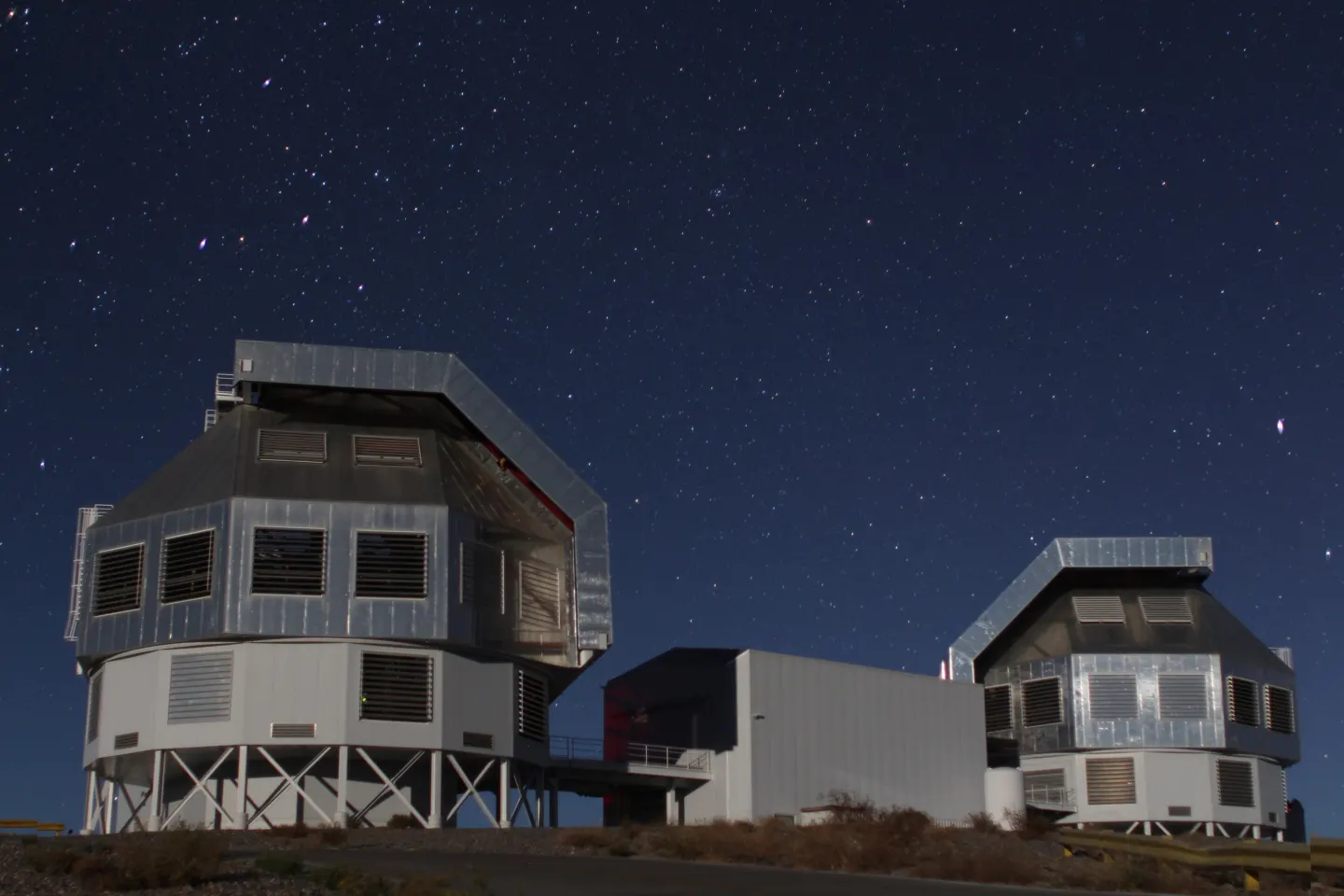
The 16 authors, led by Collin Cherubim, who recently completed a doctorate at Harvard, watched the planet cross the face of its star using WINERED, a near-infrared spectrograph mounted on the Magellan Clay telescope at Las Campanas Observatory in Chile. During a transit observed in 2024, the starlight dimmed slightly more than expected at a wavelength absorbed by helium. The team interpreted the extra absorption as helium escaping from the planet’s upper atmosphere into space.
A second planet in the system, LHS 1140 c, crossed the star on the same night. It is smaller and more strongly irradiated, and showed no helium.
According to the Center for Astrophysics | Harvard & Smithsonian (CfA), Cherubim had predicted from modelling that this particular planet should have a helium-rich upper atmosphere before any telescope time was booked. “Collin analyzed the planets we knew about and predicted that this one would have a helium atmosphere,” David Charbonneau, a co-author and head of Harvard’s astronomy department, said in the CfA statement. “Then he organized telescope time, got the data, and the detection was statistically rock solid.”
The authors argue that the result fits a picture in which lighter hydrogen has been lost to space over billions of years, leaving an upper atmosphere dominated by helium, with other gases held at lower altitudes. CfA said the atmosphere had probably survived for more than three billion years.
“This is the first time anyone has found an atmosphere on a rocky planet in the habitable zone of another star,” Cherubim said in the same statement.
What the result did not show
The detection came with a significant caveat that the paper itself reported: when the team observed the planet again in 2025, the helium signal was not there. The authors described this as evidence that the escape varies over time.
Cherubim told the Guardian that the non-detection had been a shock and had prompted the team to re-examine the 2024 data. “Every false positive we could think of, we have confidently ruled out,” he said.
Helium in the uppermost atmosphere also says little about conditions lower down. The study did not measure the composition of the bulk atmosphere, and it could not show whether the planet has water on its surface. Yamila Miguel of Leiden Observatory in the Netherlands, who was not involved, told the Guardian that the observations concerned gas leaving the upper atmosphere rather than regions near the surface. “Therefore I do not think these results have any direct implications for detecting life on other planets,” she said.
Jayne Birkby, a professor of astrophysics at the University of Oxford, also not part of the team, told the newspaper the finding was a crucial step towards understanding planets around red dwarfs. Such stars are the most common type and offer the best nearby targets, but they are often active enough to strip the atmospheres from rocky planets close to them.
CfA described the work as a validation of a model, and said the method could become a tool for studying rocky-planet atmospheres from the ground.
Update
Within five weeks of publication, three independent analyses of James Webb Space Telescope data were posted to the arXiv preprint server, and none found helium. Two appeared on 13 August and one on 19 August 2026; none had been peer reviewed when posted. Each examined four transits of LHS 1140 b recorded by Webb’s NIRISS instrument between December 2023 and July 2026.
A team led by Katherine Bennett rejected the best-fit model from the ground-based detection at more than three sigma in every visit and wrote that the reported detection “may be spurious”, while adding that variability could not be excluded if detectable helium appears in roughly half of transits or fewer. Michael Radica reached a similar conclusion, noting that none of the Webb transits coincided with the 2024 observation. A third group, led by Amélie Gressier, found that the star’s own helium line varies substantially and suggested this, or an instrumental effect linked to observing conditions, could have contributed to the original signal. All three said more observations were needed.
Sources
- Helium Escaping From The Atmosphere Of A Nearby Rocky Exoplanet Orbiting In A Habitable Zone
- First atmosphere detected on a habitable-zone rocky world
- Earth-like exoplanet found to have an atmosphere
- No Helium Detected in LHS 1140 b from Four JWST NIRISS/SOSS Transits
- Strict Limits on Helium Absorption from LHS 1140 b from Four JWST NIRISS Transits
- No Persistent Helium Absorption in LHS 1140 b: Four JWST/NIRISS SOSS Transits and Multi-epoch Stellar He I Variability
Spotted an error? See how to request a correction.