From the archive Report
Clear skies over Spain, cloud over Iceland for August’s total solar eclipse
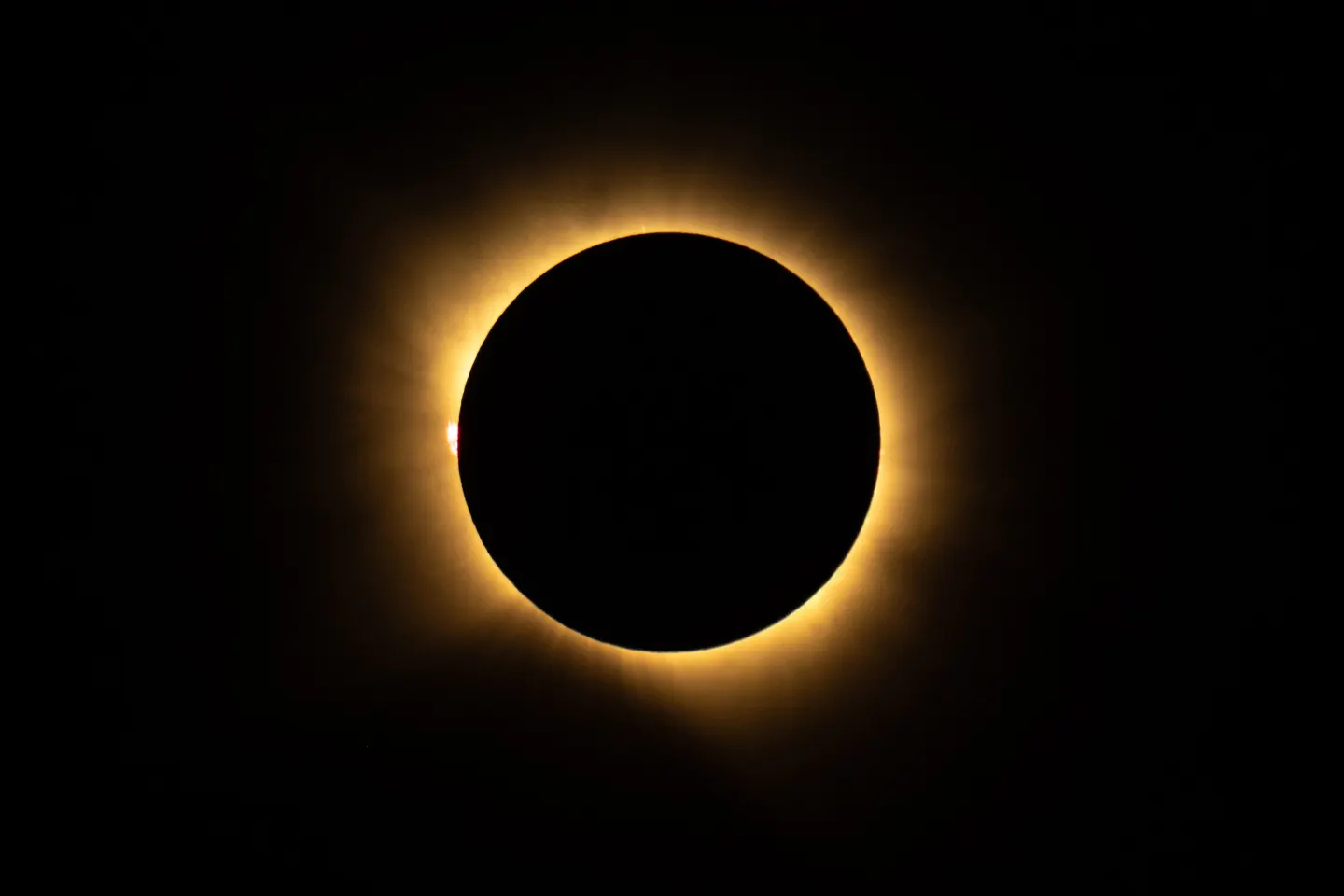
The Moon's shadow crossed Greenland, Iceland and northern Spain on 12 August 2026. Research teams used a high-altitude jet and balloons to work above the weather.
- Event date
- Published
- Reading time
- 3 min
Key points
- Totality on 12 August 2026 lasted up to 2 minutes 18 seconds, near Iceland; it crossed northern Spain shortly before sunset.
- Skies were largely clear in Spain; cloud blocked the view at sites in Iceland.
- NASA flew a WB-57F jet at 50,000 feet and funded student balloon flights to observe regardless of weather.
- Southern Spain is in the path of another total eclipse on 2 August 2027.
For a little over two minutes at most on 12 August 2026, the Moon covered the Sun completely along a narrow track running from the Arctic across Greenland, western Iceland and the northern half of Spain to the Balearic Islands. Observers in Spain largely had the clear skies they had hoped for. Many in Iceland did not.
The longest totality, 2 minutes 18 seconds, occurred near Iceland, according to Spain’s National Geographic Institute (IGN), the government body that publishes the country’s official eclipse calculations. Iceland saw the eclipse in the afternoon; by the time the shadow reached Spain the Sun was close to setting. In A Coruña, on the Atlantic coast, totality came at about 20:28 local time and lasted 76 seconds with the Sun roughly 12 degrees above the horizon. In Burgos it lasted 104 seconds with the Sun at about 8 degrees, and in Palma de Mallorca the eclipsed Sun stood only about 2 degrees up.
IGN listed more than 20 provincial capitals inside the path, among them Oviedo, León, Bilbao, Zaragoza and València. Madrid lay just outside it and saw a deep partial eclipse. A partial eclipse was visible across much of Europe, North Africa and parts of North America; in the United Kingdom the Moon hid more than 90 per cent of the Sun, Scientific American reported.
Crowds and weather
Spain had prepared for large movements of people. In a report published on the morning of the eclipse, the Guardian said officials estimated that as many as 6 million people could travel into the path, that about 460,000 visitors had come from abroad, and that more than 24,000 police officers were to be deployed. The same report noted forecasts of temperatures up to 40C and a high wildfire risk, and described the event as the country’s first total solar eclipse in more than a century.
Weather decided who saw the corona, the Sun’s faint outer atmosphere that becomes visible only during totality. Astronomy magazine, which had correspondents in both countries, reported clear and sunny conditions at sites including Burgos and León. On Iceland’s Snæfellsnes peninsula its editor described rain and thick cloud, with a brief gap just before totality that then closed; she recorded a temperature drop of about 6C and seabirds falling silent. NASA, summarising the day on 21 August, said totality was visible only to those in the path who had clear skies.
Science above the clouds
Several research efforts were designed not to depend on the ground view. A NASA WB-57F jet flew at 50,000 feet (about 15 kilometres) off the coast of Iceland, passing through the Moon’s shadow so as to lengthen its time in totality. Its cameras recorded the corona and prominences — loops of gas that appear pink at the Sun’s edge — in visible light and at three infrared wavelength ranges. A team led by the Southwest Research Institute in Boulder, Colorado, is analysing the images, NASA said; its 21 August summary reported no scientific findings yet.
Student teams funded by NASA launched scientific balloons from Iceland and Spain. Cloud blocked the view from the ground at Mosfellsbær, but the agency said the balloon instruments still collected data on how the brief loss of light and heat affected the lower atmosphere. A team from Montana State University flew a camera from Spain that filmed the shadow sweeping across the atmosphere.
On the ground near León, the NASA-supported DEB Initiative assembled a composite image of the corona, which was compared with a forecast of the corona’s shape issued that morning by the company Predictive Science. The European Space Agency broadcast totality live from the Javalambre astrophysical observatory in Spain. From the International Space Station, 262 miles (about 420 kilometres) above Quebec, astronaut Jessica Meir photographed a partial eclipse in which the Moon covered about 18 per cent of the Sun.
The next one
Spain will not wait long for another. A total eclipse with a considerably longer totality crosses southern Spain and North Africa on 2 August 2027, and IGN lists an annular eclipse, in which a ring of the Sun remains visible, on 26 January 2028.
Sources
- NASA Shares Views of August Solar Eclipse from Ground, Air, Space
- Visible eclipses in Spain in 2026, 2027, and 2028 - The total eclipse on 12 August 2026
- Total solar eclipse 2026: As it happened from Iceland
- ‘It’s going to be spectacular’: Millions flock to Spain seeking best view of total solar eclipse
- See the 2026 total solar eclipse from around the world
Spotted an error? See how to request a correction.